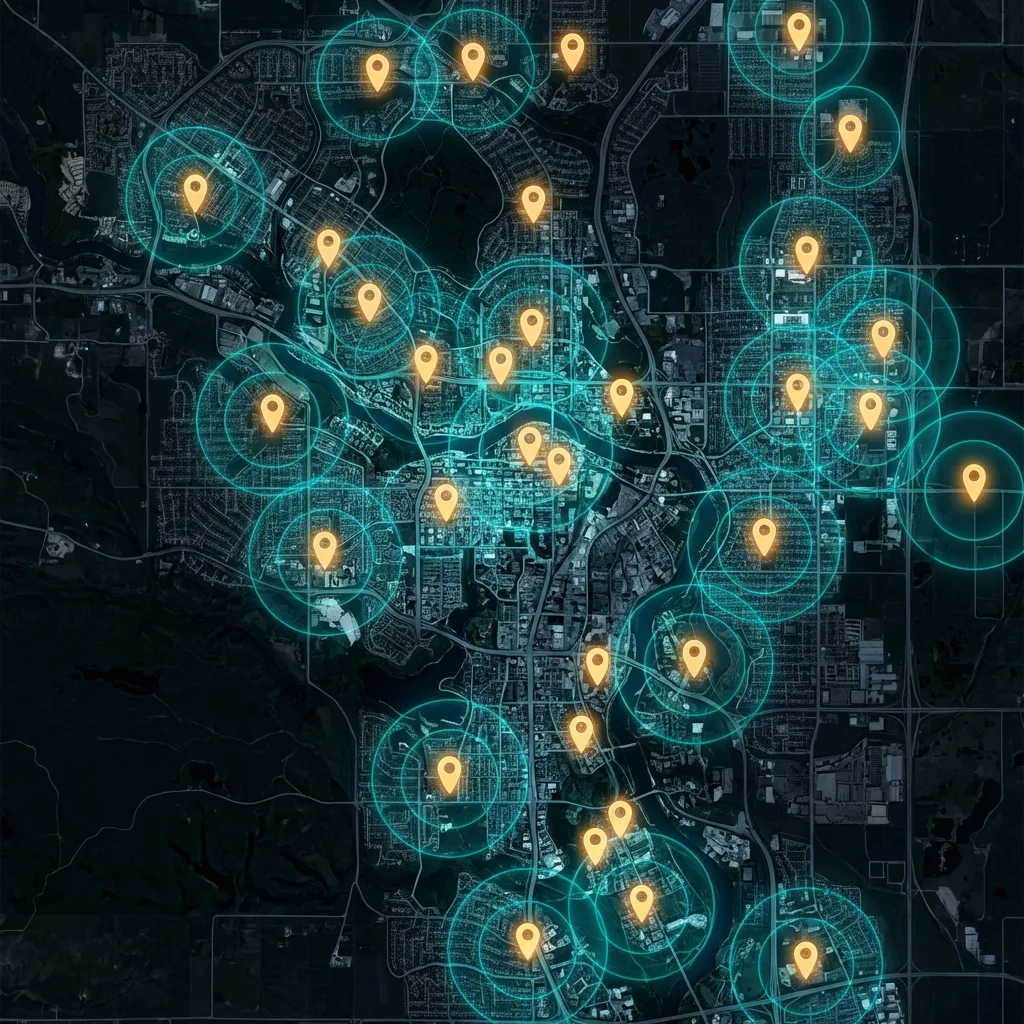
Ranking in Calgary's local search results takes more than a claimed Google Business Profile and a phone number on your website. We've audited local businesses across every quadrant of this city, from dental clinics on Macleod Trail to plumbing companies in the NE industrial parks, and the ones who actually show up when someone searches "near me" are doing five or six things right that their competitors haven't even started.
Your Google Business Profile matters. We're not going to pretend it doesn't. But if your entire local SEO strategy starts and ends with GBP, you're building on one leg. The businesses pulling the most local traffic in Calgary have consistent citations across a dozen directories, structured data their competitors don't even know exists, a review strategy that goes beyond hoping customers remember to leave one, and content that actually mentions the neighbourhoods and communities they serve. That's what this piece covers.
Your Google Business Profile Still Needs Work
We said this article goes beyond GBP, and it does. But we can't skip over the fact that most Calgary business profiles we audit are incomplete. Not unclaimed. Incomplete. There's a difference.
Google's own data shows that businesses with complete profiles are 70% more likely to attract location visits and 50% more likely to lead to a purchase. And according to Whitespark's 2026 Local Search Ranking Factors survey, your GBP signals still make up the single largest cluster of ranking factors for the local map pack. That hasn't changed.
Here's what we see wrong most often with Calgary businesses:
Categories that are too broad. A Vietnamese restaurant listed under "Restaurant" instead of "Vietnamese Restaurant." A physiotherapy clinic listed as "Health & Wellness." Google offers hundreds of specific categories. Pick the most precise one available, then add secondary categories for anything else that genuinely applies.
Empty service and product sections. The "Services" and "Products" tabs in GBP are separate fields. Most businesses leave them blank or dump everything into a single paragraph. Each service should have its own entry with a clear description. When someone asks Google "who does commercial HVAC repair in Calgary NE," Google needs structured service data to match you to that query. A one-liner that says "We do heating and cooling" won't cut it.
Stale photos. Google has publicly stated that businesses with photos receive 42% more requests for driving directions and 35% more website clicks. Your GBP photos should be from the last 12 months. Not your grand opening shots from 2019.
Inconsistent hours. If your website says you close at 5:00 PM but your GBP says 6:00 PM, you've just introduced doubt. Whitespark's data flags "business being open at the time of search" as the fifth most influential local pack ranking factor. Wrong hours can literally push you out of results during your own operating hours.
And here's something that feeds directly into AI search: your GBP data is now a primary source for AI assistants. When Google's AI Overviews summarize local options, they pull from your profile. When ChatGPT answers a local business question, it cross-references Bing data with your GBP. We wrote about how this works in our guide to local business AI search visibility. If your profile is thin, AI assistants will either skip you or fill in the blanks with guesses.
Citations and NAP Consistency Across Calgary Directories
Your Name, Address, and Phone number (the NAP) needs to match everywhere. Not approximately. Not "close enough." The same format, every time, on every listing.
This sounds tedious because it is. But the impact is real. Inconsistent citations can decrease local rankings by up to 16% according to Whitespark's research. And the problem compounds: one wrong listing gets scraped by aggregators and replicated across dozens of other sites. A single typo in your address on YellowPages.ca can end up on Canpages, Foursquare, and 15 other directories you've never heard of within months.
The businesses that dominate Calgary local search aren't the ones with the best websites. They're the ones whose information is most consistent across every directory, profile, and listing on the web.
For Calgary-area businesses specifically, here are the directories that matter most:
Tier 1 (get these right first):
- Google Business Profile
- Bing Places for Business
- Apple Maps Connect
- YellowPages.ca
- Better Business Bureau (bbb.org, Calgary and Southern Alberta chapter)
Tier 2 (important for local authority):
- Federation of Calgary Communities Business Directory
- Calgary Business Directory (calgarybusinessdirectory.com)
- Canpages.ca
- Industry-specific directories (e.g., HomeStars for contractors, Zomato for restaurants)
Tier 3 (supporting citations):
- Facebook Business Page
- LinkedIn Company Page
- Yelp Canada
- TripAdvisor (if applicable)
The specific format decisions matter more than you'd think. If your street address is "Suite 210, 4520 Crowchild Trail SW" on your website, don't list it as "Unit 210 – 4520 Crowchild Tr. SW" on YellowPages.ca. Same place. Different text. And that's enough to make citation-matching algorithms less confident about whether these listings refer to the same business.
Tools like Moz Local, Whitespark's Local Citation Finder, and BrightLocal can audit your existing citations and flag inconsistencies. We typically run a full citation audit as part of our local SEO and analytics work because most businesses have no idea how many broken or outdated listings they have floating around.
Structured Data: The Layer Most Calgary Businesses Miss Entirely
We've written an entire guide on structured data for local businesses, so we won't repeat all of it here. But the short version is this: JSON-LD markup tells search engines and AI crawlers exactly what your business is, in a language they're built to read.
The difference between a business with proper LocalBusiness schema and one without is the difference between handing Google a filled-out form with labelled fields versus handing it a paragraph and hoping it figures out your hours, service area, and phone number on its own.
Google Search Central's documentation is explicit about what to include. The required properties (name, address, geo-coordinates) are the minimum. The recommended properties are where you pull ahead of competitors: openingHoursSpecification, areaServed, hasOfferCatalog, priceRange, aggregateRating.
For Calgary businesses specifically, your areaServed property should list the communities you actually serve. Not just "Calgary." Include Airdrie, Cochrane, Chestermere, Okotoks, and any other surrounding communities where you take clients. AI assistants use geographic signals from your schema to match you to "near me" queries in those areas.
Here's a stripped-down example of what the areaServed property looks like:
"areaServed": [
  {
    "@type": "City",
    "name": "Calgary",
    "sameAs": "https://en.wikipedia.org/wiki/Calgary"
  },
  {
    "@type": "City",
    "name": "Airdrie",
    "sameAs": "https://en.wikipedia.org/wiki/Airdrie,_Alberta"
  },
  {
    "@type": "City",
    "name": "Cochrane",
    "sameAs": "https://en.wikipedia.org/wiki/Cochrane,_Alberta"
  }
]
This isn't hard to implement. It sits in a <script> tag in your page's <head>, invisible to visitors. But according to our audits, fewer than 10% of Calgary small business websites have any structured data beyond whatever their WordPress theme auto-generated — which is usually incomplete or outright broken. This is a competitive gap wide enough to drive a truck through, and it matters more now that AI systems are pulling from structured data to build their answers. We covered why in our piece on how Google's AI Overviews work.
Local SEO Checklist for Calgary Businesses
- Complete every field in your Google Business Profile: categories, services, products, photos, hours, Q&A
- Audit your NAP consistency across all directories (use Moz Local, Whitespark, or BrightLocal)
- Claim listings on YellowPages.ca, BBB Calgary, Bing Places, Apple Maps, and at least two Calgary-specific directories
- Add LocalBusiness schema with
areaServedlisting Calgary and every surrounding community you serve - Include
hasOfferCatalogin your schema with individual service entries - Build a review generation system (ask every satisfied customer, and respond to every review)
- Create location-specific content mentioning Calgary neighbourhoods naturally
- Check that your website loads in under 3 seconds on mobile (76% of "near me" searches happen on phones)
Reviews: The Ranking Factor You Can't Fake
BrightLocal's 2026 Local Consumer Review Survey found that 68% of consumers will only use a business with four or more stars. That's up from 55% just one year earlier. And 31% now require 4.5 stars or higher before they'll even consider you.
But the star rating alone isn't the full picture. Whitespark's ranking factors data consistently places review signals (volume, velocity, recency, and diversity) among the top three factors for local pack rankings. Getting 40 reviews in January 2024 and then nothing for two years looks suspicious to both consumers and algorithms. You need a steady flow.
Here's what actually works for Calgary businesses we've worked with:
Ask at the point of satisfaction. Not three days later via email. The best time to ask for a review is when the customer is happiest. Right after a successful appointment, delivery, or project handoff. A plumber in Kensington we worked with doubled his review count in four months by simply handing customers a card with a QR code to his Google review page before leaving the job. We cover more strategies like this in our guide to websites for trades and home service businesses in Alberta site.
Respond to every single review. Positive and negative. BrightLocal's data shows 88% of consumers would use a business that responds to both. Only 47% would consider one that doesn't respond at all. Your responses also give you a chance to include natural keywords and location mentions. "Thanks for choosing us for your Bridgeland kitchen renovation" does double duty as a customer touchpoint and a local signal.
Don't ignore review platforms beyond Google. Consumers now check an average of six review sites before making a decision. For Calgary, that means Google, Facebook, Yelp, and whatever industry-specific platform applies to your trade: HomeStars for contractors, Zomato or Google Maps for restaurants, Healthgrades or RateMDs for healthcare. AI assistants like ChatGPT are now the third most popular source of business recommendations, up from 6% to 45% in a single year according to BrightLocal. Those AI tools pull review data from everywhere.
Never buy reviews or incentivize them with discounts. Google's policies are clear, and their detection is getting sharper. A restaurant in Beltline that we audited had 30 five-star reviews removed overnight because they'd been running a "leave a review, get 10% off" promotion. The recovery took months.
Content Localization: Stop Writing for "Canada" and Start Writing for Calgary
This is where most local businesses fall flat. Their website says "serving clients across Western Canada" and never mentions a specific neighbourhood, community, or local landmark. Search engines can't figure out where you actually operate, and neither can AI assistants.
Local content doesn't mean stuffing "Calgary" into every sentence. It means being specific about where you work and weaving that into your content naturally.
Create individual service-area pages. If you serve Airdrie, Cochrane, Okotoks, and Chestermere in addition to Calgary proper, each of those communities deserves its own landing page. Not a page that's identical to your Calgary page with the city name swapped out. Google penalizes thin duplicate content. Each page needs unique content about that community: the types of clients you serve there, projects you've done, local considerations (like Cochrane's rapid growth creating demand for new home services, or Airdrie's mix of residential and light industrial properties).
Reference Calgary neighbourhoods in your content. "We serve southwest Calgary" is okay. "We've worked with restaurants along 17th Avenue SW, dental clinics in Marda Loop, and law firms in the Beltline" is much better. Those neighbourhood names are search terms. People in Calgary search for "plumber in Kensington" or "accountant near Chinook Centre," not just "plumber in Calgary."
Write about local topics. A roofing company could write about how Calgary's hailstorms affect roof lifespans differently than other Alberta cities. An HVAC company could cover how our extreme temperature swings (minus 30 to plus 5 in a single chinook) stress heating systems in ways that are unique to this region. A web developer (like us) writes about how AI search affects local Calgary businesses. The local angle makes the content more useful and more specific to the people you're trying to reach.
Use schema markup to reinforce your geography. We mentioned the areaServed property earlier, but your visible content and your structured data need to agree. If your service pages mention Okotoks but your schema only lists Calgary, you're sending mixed signals. Consistency between what humans read and what machines parse is the whole game.
What This All Adds Up To
The businesses that consistently appear in Calgary local search results, and increasingly in AI-generated answers, aren't doing any one thing brilliantly. They're doing six or seven things consistently. A complete GBP profile. Clean citations across the right directories. Schema markup that tells machines exactly what they are and where they operate. A steady stream of real reviews with real responses. Content that mentions the actual communities they serve. And the patience to keep it all updated.
None of this is glamorous work. There's no single hack that jumps you to the top of the map pack overnight. But in a market like Calgary, where most businesses are still running on an outdated GBP profile and zero structured data, doing these things puts you ahead of the vast majority of your local competitors. And as AI search continues to grow (45% of consumers now use AI tools for local recommendations, up from 6% just a year ago), the businesses with the clearest, most consistent digital identity are the ones that will keep showing up.
If you're not sure where your local SEO stands right now, we offer discovery sessions and technical audits that cover everything in this article and more. We'll tell you what's working, what's broken, and what to fix first.
Sources
- Whitespark — 2026 Local Search Ranking Factors
- BrightLocal — 2026 Local Consumer Review Survey
- BrightLocal — Local SEO Statistics 2025
- Google Search Central — Local Business Structured Data
- Schema.org — LocalBusiness Type
- Whitespark — Review Recency as a Ranking Factor
- Moz — Local SEO and Citation Building
- YellowPages.ca — Calgary Business Directory